
Mental reps for BJJ, between sessions.
The mats are two or three hours a week. The decision layer is yours to train every day, five focused minutes at a time.
A mental rep is not picturing yourself hit a flawless armbar in slow motion. That is a highlight reel, and your brain knows the difference. A real mental rep is a decision you commit to. You put yourself in a specific position, you face a specific problem, you choose a specific response, and then you check whether you were right. The commitment is the whole thing. Vague visualization asks nothing of you; a committed call forces your brain to actually retrieve an answer, and retrieval is what builds the reflex.
Take a concrete one. You are flattened under side control. What is your first move? If your honest answer is to bridge as hard as you can, you have just found a hole, because the first move is to build your frames, forearm into their neck and hip, before you try to move your hips at all. Frames make the space; the shrimp uses it. That back-and-forth, pose the problem, commit to an answer, check it, is one mental rep. Do a handful of those a day and the position stops being a place you panic and becomes a place you have a plan.
Watching instructionals isn't reps
There is a comfortable trap here, and most people live in it. You watch an instructional, the coach explains the escape, and every step makes sense as it goes by. You nod. It feels like learning. But nothing was retrieved. You recognized the answer as it was handed to you, which is a completely different skill from producing it yourself with a training partner grinding down on you.
This is the recognition trap, and it is why people can watch fifty hours of side control escapes and still get stuck flat on their back. Recognizing a technique when you see it demands nothing. Recalling it cold, from just the feeling of being pinned, is the skill that transfers to a live round. Passive watching trains the first and skips the second entirely. A mental rep flips it: no answer is shown, you have to pull it out yourself, and if you cannot, you have found exactly the gap worth closing.
A mental-rep protocol that works
Here is a loop you can run anywhere. Pick a position. Pose the branch question out loud or in your head: I am in low mount, their weight is forward, what do I do? Commit to an answer before you let yourself check it. Then check, and move to the next branch. In that example the answer is the upa, the bridge-and-roll, because forward weight in low mount is exactly what the upa needs. If they climb to high mount near your armpits, the upa gets much harder and the elbow-knee escape to recover guard becomes the better call. Two branches, two committed answers, about thirty seconds.
The rules that make it work are simple. First, always commit before checking, because the guess is where the retrieval happens. Second, keep it specific, a named position and a named problem, never something as loose as get better at mount escapes. Third, when you get one wrong, run it again immediately. This fits the dead time you already have: the commute, the ten minutes before you fall asleep, a rest day when your body needs off but your head does not.
When you're hurt and off the mat
This is where mental reps earn their keep. An injury takes your body off the mat, but it does not have to take your jiu-jitsu with it. The decision layer, the reading and the calls, does not need your knee to be healthy. You can keep it sharp through the entire lay-off and walk back in weeks later with your recognition intact even though your body is rusty.
The people who come back sharpest are the ones who kept training the part they still could. Six weeks off with a bad shoulder is six weeks you can spend running branches: side control escapes, guard retention, the reads that do not care about your shoulder. When you return, your body needs a few sessions to remember how to move, but you are not also relearning what to do, because you never stopped deciding. Compare that to going completely cold for six weeks, where you come back a beginner twice over. If you are hurt right now, this is the most productive thing you can do with the time, and it is genuinely training, not a consolation prize.
How Underhook structures it
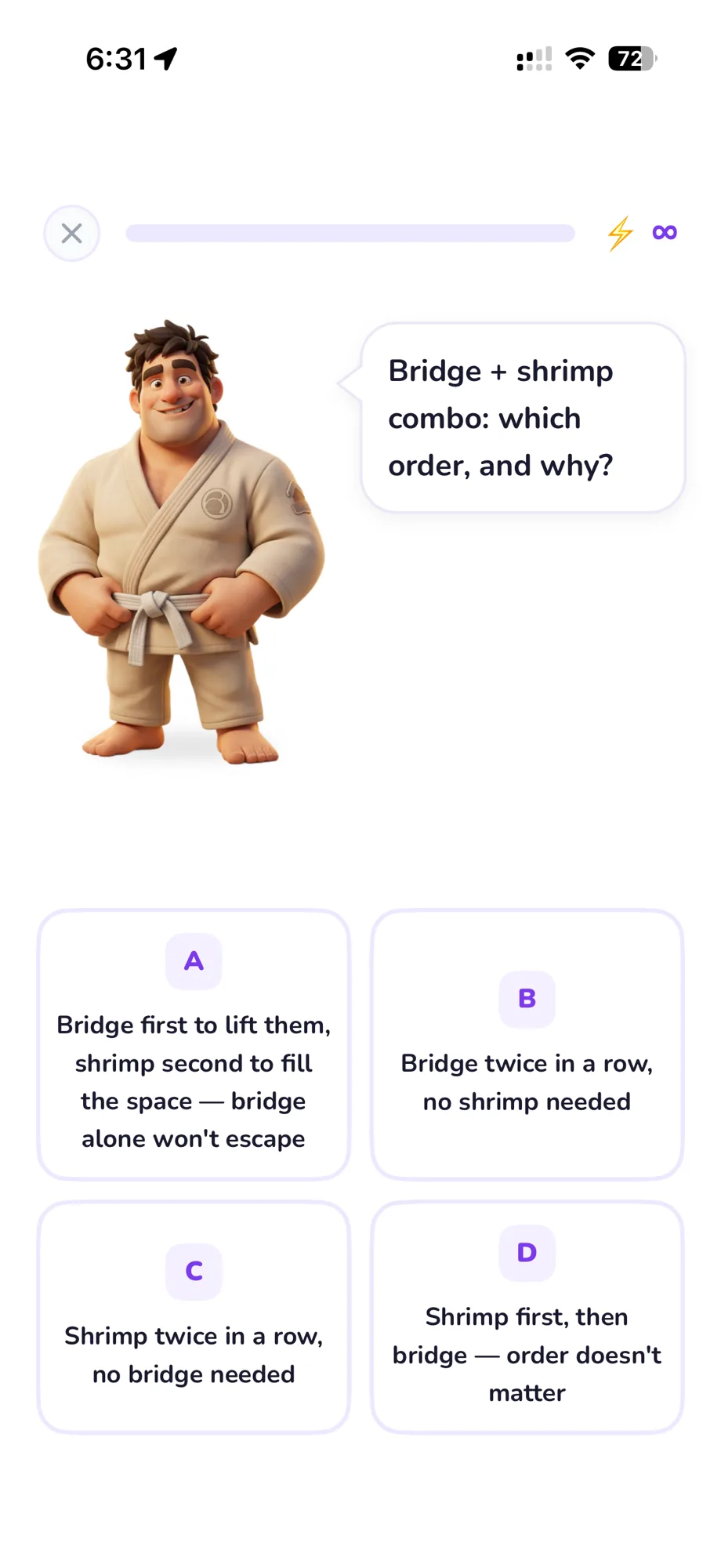
Underhook takes that loop and runs it for you. Every question is a committed decision: a real position, the branches that exist there, and a call you have to make before you see whether it holds. You are not shown the answer and asked to nod. You are asked, you answer, and you find out. That is a mental rep, delivered one after another, five focused minutes at a time.
It also handles the spacing so you do not have to. The positions you decide on come back on their own schedule, resurfacing right around when a memory would start to fade, so the reps land when they do the most good. No gear, no partner, no mat. Whether you are between sessions, on the couch on a rest day, or stuck in a sling for a month, the decision layer keeps getting trained.
Mental rep questions
Is this the same as visualization?
No. Visualization usually means replaying a technique going perfectly in your mind. A mental rep asks you to make a decision from an unfinished position and commit to it before you check. One rehearses a highlight; the other trains the choice you actually have to make.
How many mental reps a day is worth doing?
A handful. Five focused, committed decisions beat an hour of drifting daydreams. The value is in the commitment and the check, not the volume, so a short honest session does more than a long passive one.
Can mental reps replace mat time?
No. You still need the mat to feel positions and to drill technique into your body. Mental reps train the decision layer that sits on top of that, and they train the part you can keep working when you cannot get to class.
I'm injured and can't train. Is this actually useful?
It is one of the most useful things you can do. The reading and the calls do not need your body to be healthy, so you can keep them sharp through the whole lay-off and come back with your recognition intact while your body catches up.