
BJJ is a decision tree. Train it like one.
Every position branches. Two or three real options, then a consequence. Underhook trains yours, five focused minutes a day, no gear and no partner.
Ask a coach what to do from a position and you rarely get a straight answer. You get a question back: what is your opponent doing? That is the real shape of jiu-jitsu. A position is not one move you memorize. It is a node with a few branches, and which one you take depends entirely on what the person under or over you does next.
Picture any position as a fork in the road. You are in closed guard. Their posture is broken, or it is not. Their weight loads one leg, or it does not. Each fact sends you down a different branch, and each branch ends in a consequence: a sweep, a submission, a scramble, or a pass you just handed over. Grips and reactions are the branches, positions are the nodes, and a consequence sits at the end of every path.
Most instruction teaches the branches one at a time, cut off from the fork that should trigger them. You learn a sweep on Tuesday and a choke on Thursday and never build the map that says which one this moment is asking for. Underhook trains that map directly: the read, the fork, the call, five focused minutes at a time, no partner and no mat required.
A real branch: closed guard, bottom
Here is one node drawn out. You are on the bottom, guard locked around their waist. Before any attack, one question runs everything: is their posture broken, or not?
Closed guard, you on the bottom. One question first: is their posture broken?
- They stand up to pass → Pull them forward and break their posture down before they base out. Do not open your guard to chase them as they rise.
- They sit tall, straight arms, good posture → Break the posture first. Grip the collar and pull their head toward your chest, not straight up. A choke, sweep, or armbar barely exists against a posted-up opponent.
- They post a hand on your chest or frame a forearm across your neck to make space → Grab that wrist and drag it across your body. A dead arm is not a frame, and the posture collapses again.
- Posture is broken and their weight settles onto one leg → Hook that loaded leg. A leg carrying weight has no base under it, and that is where the sweep lives.
One trap under all of it: clamping your ankles tight feels like control, but a dead lock invites a footlock and does nothing to stop a stack. Active hips break posture; a crossed pair of ankles does not.
That is three decision points and a warning, all hanging off one node. Not one of them is a technique name. They are reads and responses. You never simply do the collar choke; you register a fact about your opponent, take the branch that fact opens, and the submission is the last thing to happen, almost an afterthought.
Why paper flowcharts don't survive live rolls
You could draw that whole tree out, pin it to the wall, and study it before class. It would not help much. In a live roll there is no time to consult a diagram. The gap is between recognition and recall. Recall is dragging an answer out of a blank page; recognition is seeing a situation and knowing the response before you have finished thinking. Under a heavy training partner, only recognition is fast enough.
A flowchart trains recall in the worst way. You read it, you nod, and nothing gets pulled out of your own head. The branch you need has to become a reflex, keyed to what you actually see and feel, so the pull-their-head-down response fires the instant they posture up. You do not need the map on the wall. You need the branch already in your head, retrievable under pressure, and that is a kind of practice almost nobody does between sessions.
How to train your tree
You can build this without a partner in about five minutes. Pick one position for the week, closed guard bottom is a good start because everything keys off that single posture question. Before class, self-quiz the branches: they stand, what do I do; they post a hand, what do I do; their weight loads a leg, what do I do. Commit to each answer before you check it, because guessing then confirming beats re-reading every time.
After class, work the branch you lost. Got stacked and could not break their posture? Run it on the way home: the read, the right response, what you did instead. Add a second position the next week and let the first resurface now and then so it does not fade. One node at a time, the reads compound and the map becomes yours.
How Underhook trains it
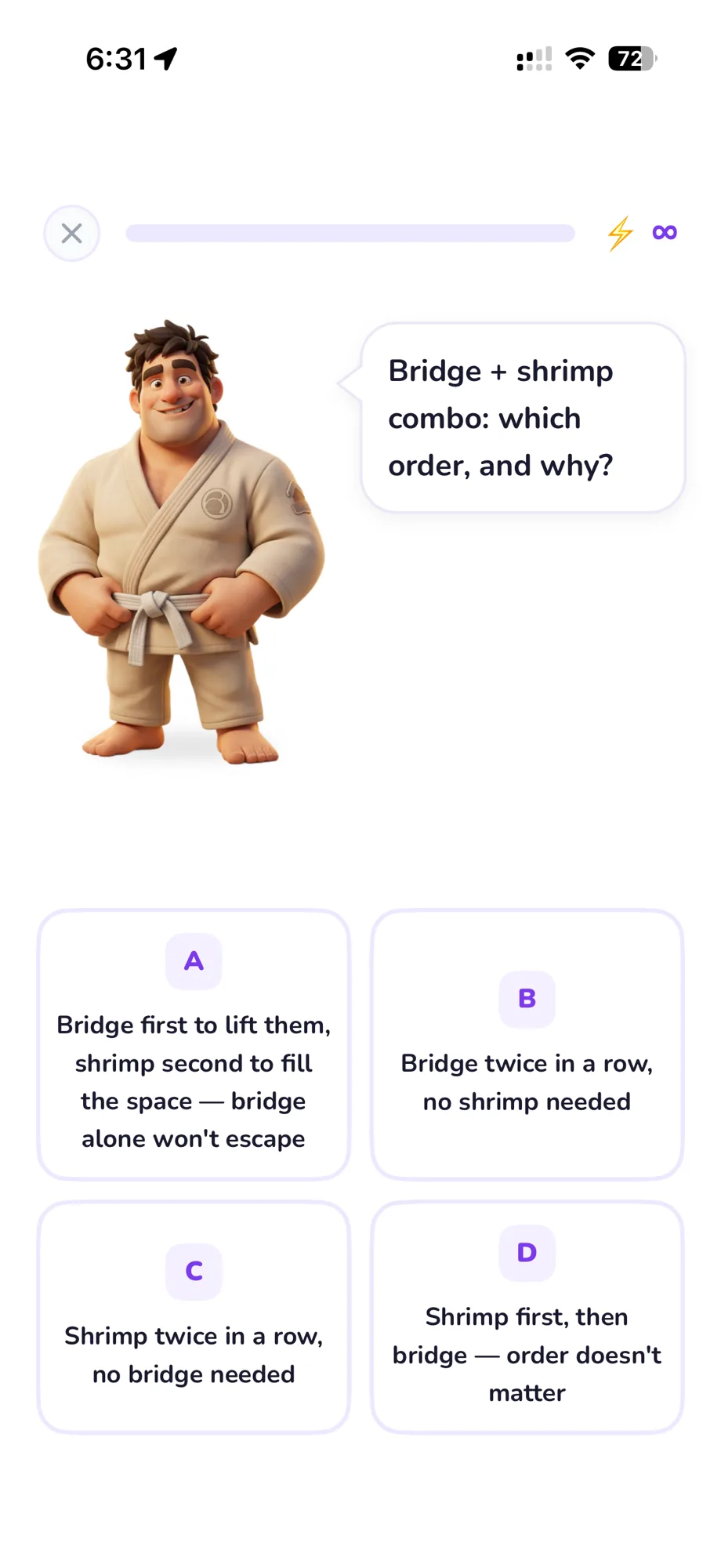
Underhook turns every one of those forks into a five-minute session on your phone. Each question drops you into a real position, gives you the two or three branches that actually exist there, and asks for the call. You answer, find out immediately whether the branch holds, and move on. No lecture, no video to nod along to. Every prompt is a decision you will genuinely face on the mat.
The positions you have seen resurface on their own schedule, so a branch you trained last week comes back right around when you would otherwise forget it. Over a few weeks the whole tree gets reps, not just the parts you happened to hit in live rounds. It is the map, trained the way the mat asks for it, five focused minutes at a time, no gear.
Decision tree questions
Decision tree vs gameplan, what's the difference?
A gameplan is the route you want to take. A decision tree is every route available from where you actually are, including the ones you did not plan for. The gameplan is for things going right; the tree is for your opponent refusing to cooperate, which is most of the time.
How many branches should a white belt learn per position?
Two or three. A position with a dozen options is a position you freeze in. Start with the most common thing your opponent does and the one response that answers it, then add the next most common. Depth beats breadth early on.
Can I train this without a partner?
Yes, and that is the whole point. The reading and the call live in your head, and those are exactly what you can rehearse away from the mat. You still need mat time to feel the position, but the decision layer can be trained daily on its own.
Does this replace drilling technique?
No. It sits on top of it. Drilling builds the branch so your body can execute it; the tree work builds the trigger so you pick it at the right moment. Almost everyone trains the first and neglects the second.