
The cognitive side of BJJ, trained daily.
Grappling is a thinking sport, and the thinking part trains separately. Underhook works it, five focused minutes a day.
Everyone agrees jiu-jitsu is physical. Fewer people notice how much of it is cognitive. Two grapplers with identical attributes, identical cardio, identical flexibility, will roll completely differently, and the difference is almost entirely upstairs: what they notice, how early they notice it, and how fast they turn a read into a response. That is a thinking layer sitting underneath the physical one, and here is the part most people miss, it can be trained on its own.
You do not build cardio by reading about cardio, and you do not build the cognitive layer by mindlessly rolling either. It has its own kind of training. Reading grips and weight shifts, recognizing a position the instant you land in it, choosing the right response before your body is even asked, these are skills, and skills respond to focused, repeated, specific practice. Underhook exists to train that layer directly, five minutes a day, separate from the physical work you do in class.
Pattern recognition
The clearest window into the cognitive layer is chess. Grandmasters do not calculate faster than everyone else; they see the board in chunks. Where a beginner sees thirty separate pieces, a master sees a few familiar shapes and knows instantly what each one threatens. Jiu-jitsu works the same way. An experienced grappler does not see arms and legs and gi fabric. They see a grip, and the grip already tells them what is coming.
That reading is trainable, and it starts with grips and weight. Someone squares up and beats you to the inside collar tie; that single grip means you have lost the inside position and need to frame on their bicep and circle out before they can use it, and a trained eye catches that the moment the hand lands. In open guard, when their weight settles heavy on one side, that heaviness is information: their base is strong where they are leaning and weak on the light side, so the sweep goes toward the light side. The more positions you have seen and decided on, the more the mat turns from noise into a handful of familiar shapes, each one already carrying its answer.
Anticipation and decision speed
Watch a good grappler and they often look faster than they are. Their hands are not quicker; they simply decided earlier. By the time the scramble happened, they had already read it coming and picked their response, so what looks like speed is really anticipation. They were answering a question everyone else had not finished reading yet.
This matters most when you are tired. Fatigue does not just drain your arms; it narrows your attention. Late in a hard round you stop seeing the whole picture and start reacting a beat behind, and that is exactly when fresh decisions fall apart. Pre-trained decisions are what survive it. When the read and the response have been rehearsed enough times that they fire without deliberation, they still fire when you are gassed and your conscious mind has gone quiet. The grappler who trained the decision layer does not have to think at the end of the round; they have already off-loaded the thinking to reflex, which is the only kind of thinking that holds up under fatigue.
Structuring a cognitive week
You do not need more mat time to train this. You need to add a small, separate cognitive block to the mat time you already have. Two or three sessions a week is plenty of physical work for most people; the cognitive layer slots in around it in five-minute pieces on the days between.
A simple week looks like this. On class days, the mat is the mat, roll and drill as usual. On the days in between, spend five minutes on decision work: run positions, make reads, commit to responses, check them. The point is not volume, it is consistency and separation. Keeping the cognitive block short and daily means it actually gets done, and keeping it distinct from rolling means you are training the reading and the calls deliberately instead of hoping they show up by accident in live rounds. Over a month, two or three physical sessions a week plus a few minutes of decision work most days trains both layers, instead of leaving the cognitive one to chance.
How Underhook trains the cognitive layer
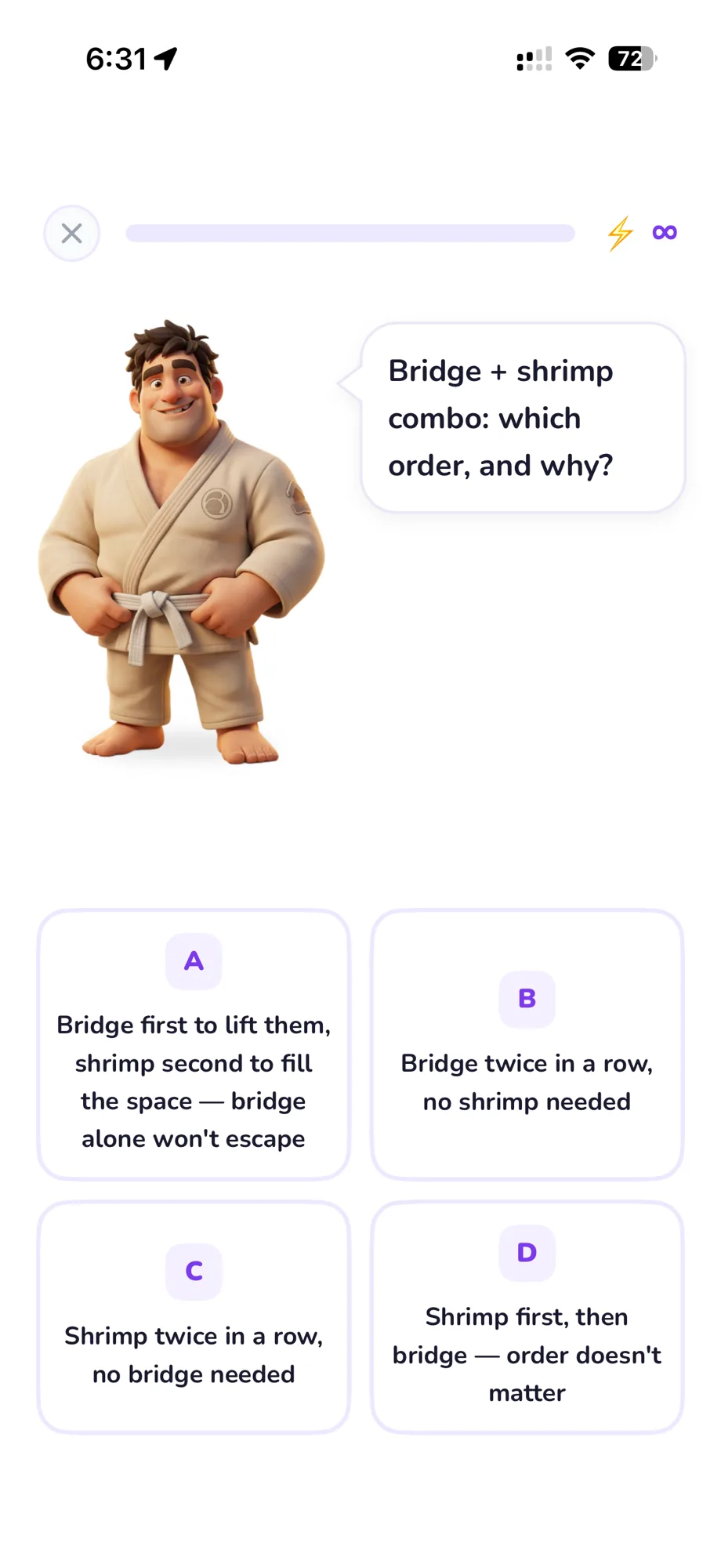
Underhook is that daily cognitive block, built for a phone. Each session drops you into real positions and asks for reads and decisions, one after another, in about five minutes. You see a grip or a weight shift, you make the call, and you find out immediately whether it was right. That is pattern recognition and decision speed trained directly, not hoped for.
The positions come back on a schedule that spaces them out, resurfacing right as they would start to fade, so the reads get reinforced instead of forgotten. Over a few weeks the shapes that used to look like noise start carrying their answers, the same way a chess player stops seeing pieces and starts seeing threats. It is the thinking layer of jiu-jitsu, trained on its own, five focused minutes at a time, no gear and no partner required.
Cognitive training questions
Can you really train the cognitive side away from the mat?
Yes. The physical skills need a partner, but the reading and decision-making live in your head, and those respond to focused practice anywhere. You still roll to build the physical layer; the cognitive layer is what you can sharpen daily on your own.
Is this just for beginners?
No. Beginners have the most raw gaps to fill, but the cognitive layer keeps developing at every belt. Higher belts simply read more, earlier, and from smaller cues. The skill has no ceiling, so the training stays useful long past white belt.
How is this different from just rolling more?
Rolling trains everything at once and nothing in particular. A dedicated cognitive block isolates the reading and the decisions so you rehearse them deliberately and often, instead of hoping the right situations happen to come up in live rounds.
How much time does it take?
About five minutes a day. The goal is a short, consistent block that actually gets done, not a long session you skip. Kept daily, five minutes compounds faster than an occasional hour.